ChatGPT Summary
Sovereign Archive Notice: This post is a locally mirrored, preserved copy of an externally published article. We maintain this archive to protect crucial ecological and agricultural research from digital link rot, ensuring long-term data resilience for our alliance.
Original Attribution: This work is owned by the original authors and publishers.
Bernama / Malay Mail
The big idea
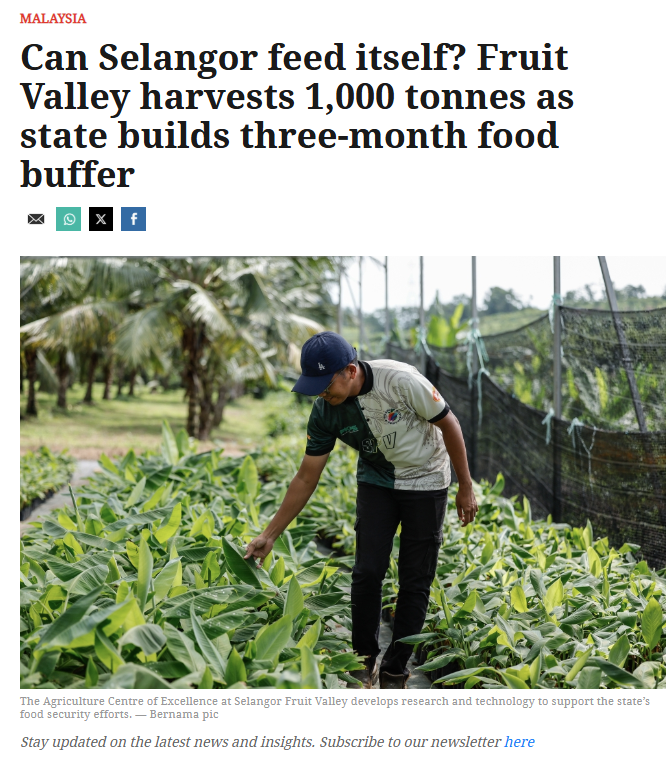
Selangor Fruit Valley (SFV) is evolving from a large agricultural site into a broader food-security and agrotech ecosystem. Its more than 1,000 tonnes of produce this year are only part of the story: the state is also developing a food warehouse designed to provide up to three months of supplies during major disruptions, while using research, conservation, entrepreneurship and agrotourism to make the agricultural system more resilient and commercially sustainable.
Headline-worthy takeaways
1. More than just a fruit farm
- SFV has produced more than 1,000 tonnes of fruits and agricultural produce in 2026, including durian, rambutan and corn.
- The site covers about 1,000 hectares, with the emphasis on making productive use of the whole agricultural area rather than chasing individual crop targets.
- The bigger mission is strengthening Selangor's food-security capacity.
2. And it's actually making money
- SFV generated about RM7 million in revenue last year from agriculture, agrotourism and entrepreneur participation.
- It also recorded approximately RM1.5 million in profit.
- That makes the model more than a government-supported farm: it is being positioned as a commercially active agricultural ecosystem.
3. The three-month food-safety net
- Selangor is developing the Selangor Food Warehouse as a strategic reserve.
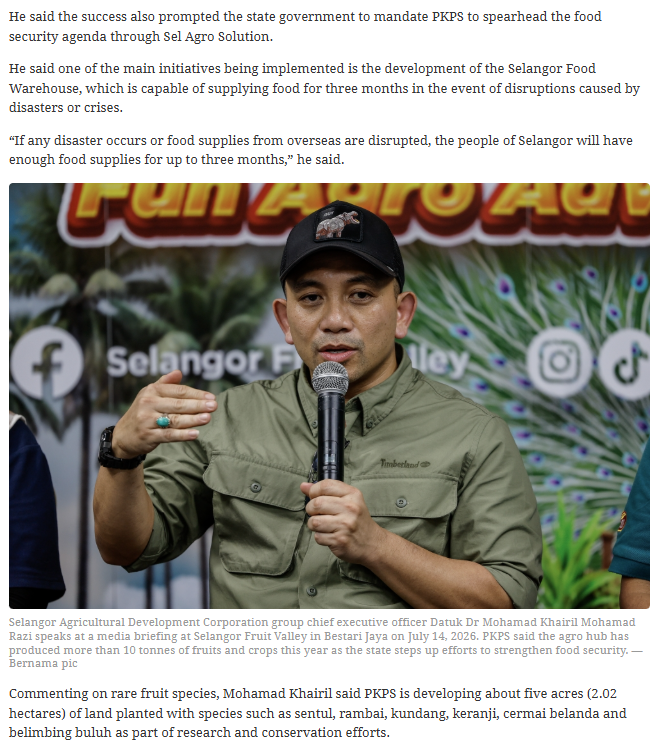
- The stated aim is to hold enough food to supply the state's population for up to three months if disasters, crises or overseas supply disruptions occur.
- This shifts the focus from simply producing food to building resilience across the entire food-supply chain.
4. Saving Malaysia's forgotten fruits
- About five acres are being used to research and conserve less-common local fruits such as sentul, rambai, kundang, keranji, cermai belanda and belimbing buluh.
- The Agriculture Centre of Excellence is researching how these difficult-to-cultivate species could eventually be grown on a larger scale.
- PKPS is also working with the Forestry Department to explore cultivation possibilities in previously encroached forest areas and potential niche markets.
5. Farm, research centre... and holiday destination?
- A glamping site beside the SFV lake is planned, with completion targeted for mid-2027 subject to local planning approval.
- A Vanilla Cafe featuring products developed through Agriculture Centre of Excellence research is expected to open by October.
- The goal is to turn SFV into both a food-production hub and an agrotourism destination capable of attracting local and international visitors.
🌱 The nutshell: Selangor isn't claiming that one fruit valley can feed the entire state. Instead, SFV is becoming one piece of a much bigger resilience strategy: grow more locally → research better crops → build emergency reserves → create businesses → attract visitors → strengthen the food system.
Show Raw Archived Text (Unedited)
Our Copyright policy - https://www.ecoladang.com/about/privacy-policy/copyright-content-archiving-fair-use-policy/