ChatGPT Summary
Sovereign Archive Notice: This post is a locally mirrored, preserved copy of an externally published article. We maintain this archive to protect crucial ecological and agricultural research from digital link rot, ensuring long-term data resilience for our alliance.
Original Attribution: This work is owned by the original authors and publishers.
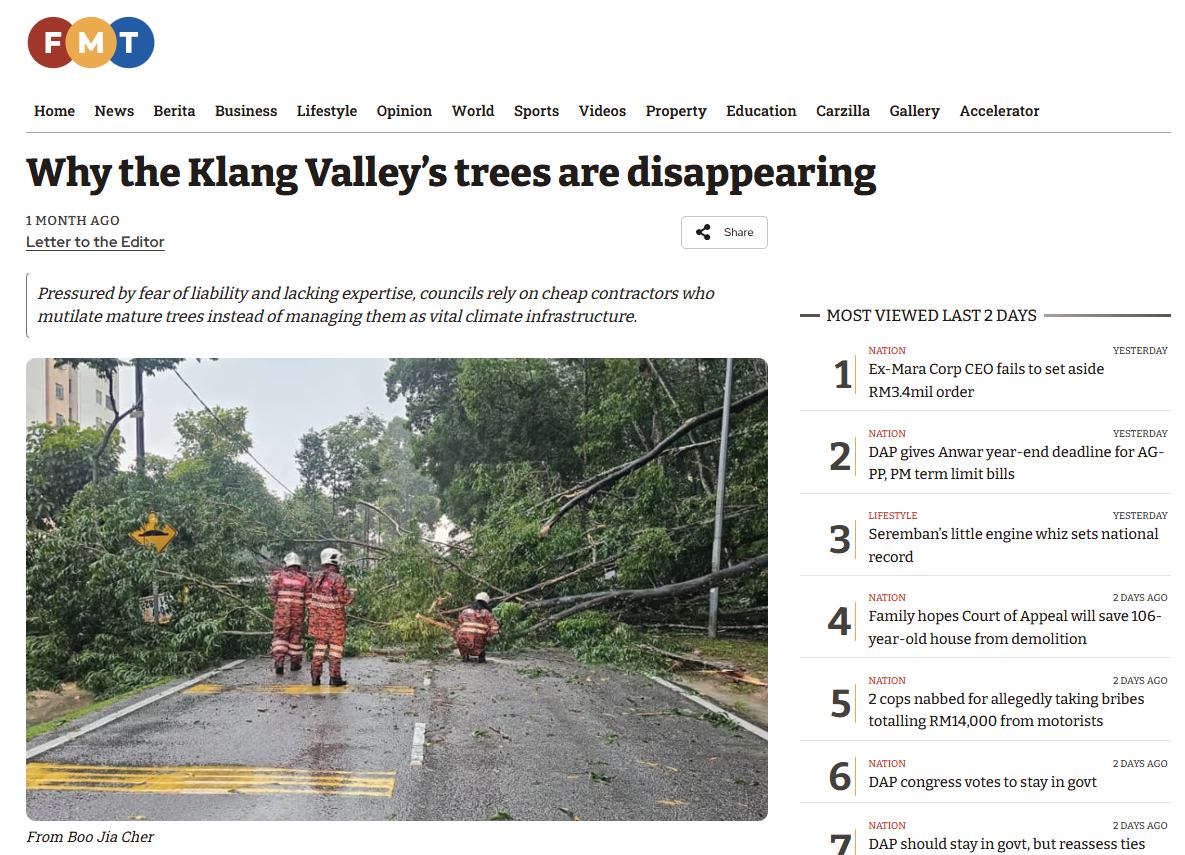
Boo Jia Cher — Free Malaysia Today
The big idea
Klang Valley's mature urban trees are increasingly being treated as liabilities rather than as essential pieces of climate infrastructure. The article argues that fear of falling branches, combined with a shortage of qualified arborists and reliance on low-cost contractors, is encouraging destructive pruning practices that can actually make trees weaker and more hazardous over time.
```Headline-worthy takeaways
1. The chainsaw is not a tree-care strategy
- The writer describes mature trees being aggressively cut after concerns that branches could fall onto vehicles.
- The article questions the idea that severe cutting is simply the “standard way” to manage urban trees.
- The wider concern is that fear of liability is shaping tree-management decisions more than arboricultural expertise.
2. Where are all the arborists?
- An arborist is a trained specialist who evaluates tree health, structural stability and appropriate pruning.
- The article argues that arboriculture remains under-recognised in Malaysia, leaving councils dependent on general contractors rather than specialist tree-care professionals.
- When speed and low cost become the main criteria, careful tree management can lose out to a chainsaw-and-labour approach.
3. “Topping” can make the problem worse
- Topping removes a tree's entire crown and is described as a destructive practice rather than responsible pruning.
- Removing the canopy deprives the tree of leaves needed for food production and leaves large wounds vulnerable to decay and fungal infection.
- Rapid regrowth can produce weakly attached shoots that may be more prone to breaking during future storms.
4. Healthy trees are climate infrastructure
- The article frames mature urban trees as valuable infrastructure rather than decorative obstacles.
- Preserving functioning canopies supports cooler, greener and more resilient urban environments.
- The argument is especially relevant as cities face stronger heat, intense rainfall and other climate-related pressures.
5. The smarter answer is expertise, not panic
- The article's central solution is better professional tree assessment and management rather than blanket removal or drastic pruning.
- Urban councils need the skills to distinguish genuinely dangerous trees from healthy mature trees that simply require proper maintenance.
- In short: manage the tree, don't automatically declare war on it. 🌳
🌳 The nutshell: The article's warning is wonderfully simple: bad tree management can create the very hazards it is supposed to prevent. Klang Valley needs qualified arborists and long-term urban-tree management if mature trees are to remain part of the region's climate-resilience toolkit.
```Show Raw Archived Text (Unedited)
Archive note: This entry preserves the article's bibliographic reference and a curator-generated summary rather than reproducing the publisher's full copyrighted text.
Our Copyright policy - https://www.ecoladang.com/about/privacy-policy/copyright-content-archiving-fair-use-policy/