Waste Pyrolysis: The Flexible Biorefinery
AI Summary: Biomass – Waste Pyrolysis
How Ecoladang operates a flexible biorefinery to generate multi-product revenue streams:
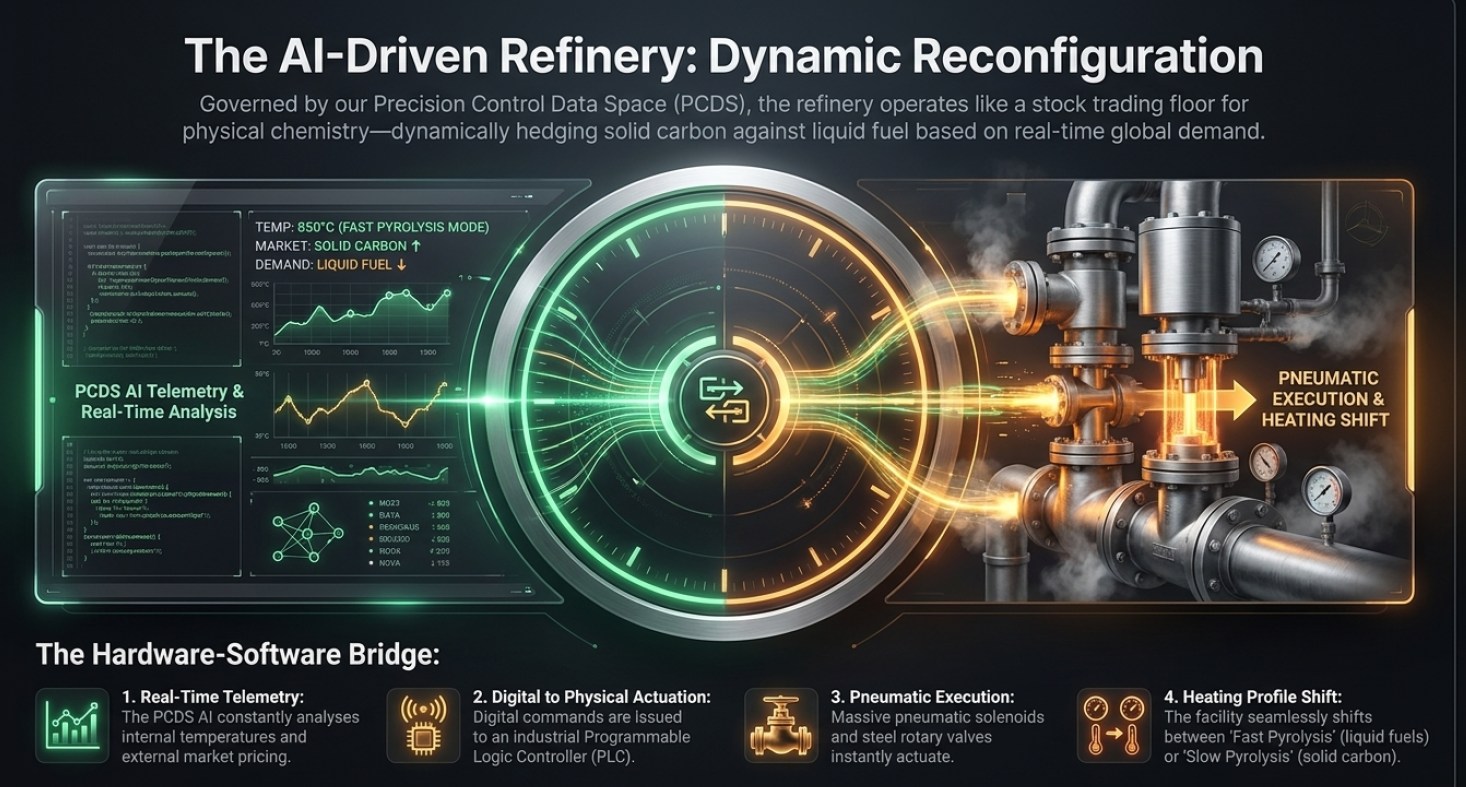
The Core Concept:Pyrolysis is an oxygen-free thermal decomposition process. Depending on market demands, the AI dynamically adjusts pneumatic solenoids and massive steel rotary valves to shift the facility's heating profile.
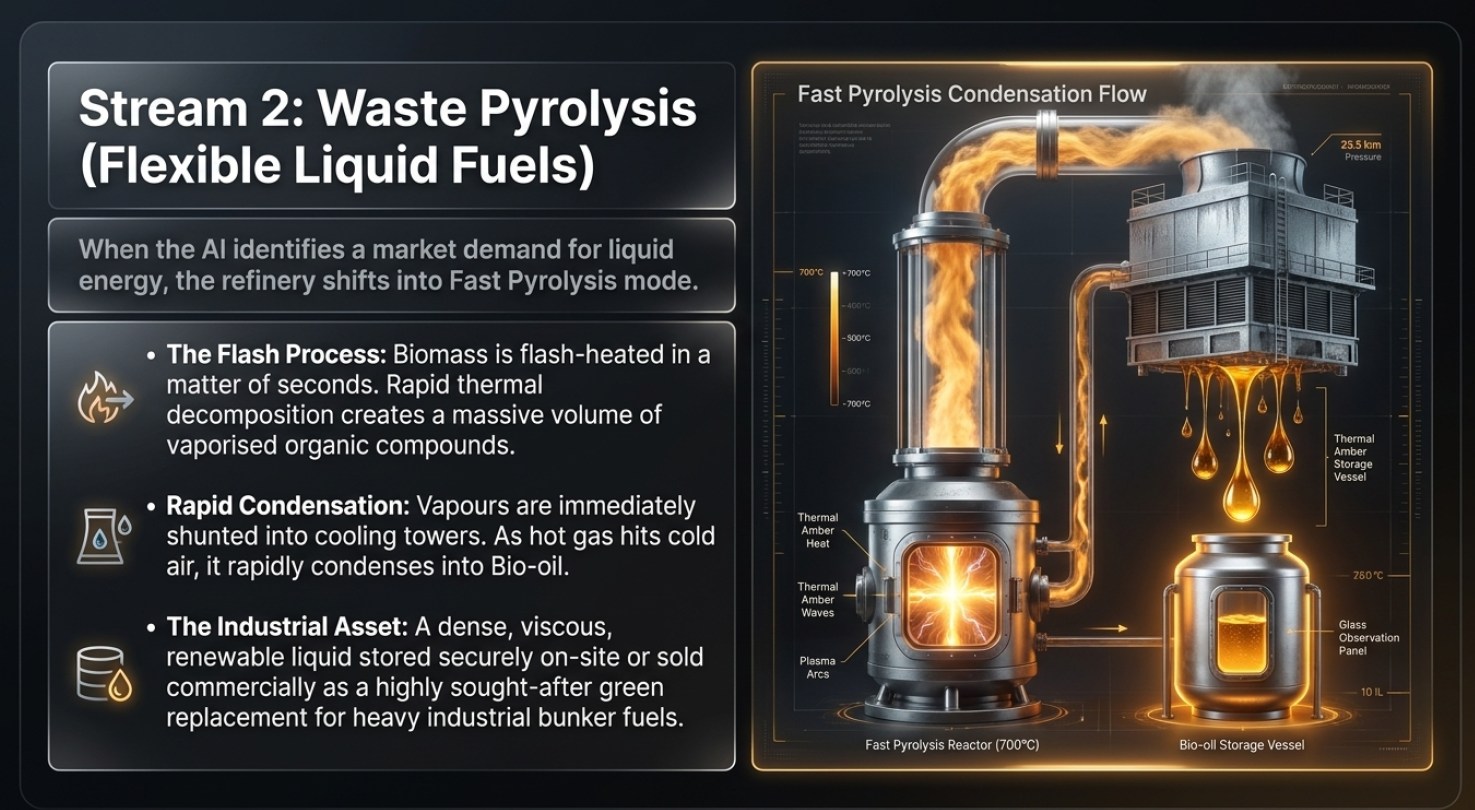
Fast Pyrolysis (Bio-oil): By flash-heating biomass in seconds and using cooling towers, the vapor condenses into dense Bio-oil—a green replacement for heavy industrial bunker fuels.
Market Agility:It operates like a stock trading floor for physical chemistry, allowing the farm to dynamically hedge physical carbon against liquid fuel based on daily global demand .
In the modern agricultural economy, survival requires adaptability. Market demands shift, commodity prices fluctuate, and energy needs change. This is why the Ecoladang Integrated Community Refinery relies heavily on Waste Pyrolysis—a high-efficiency thermal process that acts as the ultimate flexible biorefinery.
While our Gasification line is dedicated strictly to generating immediate power, Pyrolysis is designed to produce a sophisticated, diversified income portfolio . It reinforces our Zero Waste principle by converting agricultural residue (such as palm waste or fast-growing bamboo) into three distinct, high-value outputs simultaneously: Bio-oil, Biochar, and Syngas.
While our Gasification line is dedicated strictly to generating immediate power, Pyrolysis is designed to produce a sophisticated, diversified income portfolio . It reinforces our Zero Waste principle by converting agricultural residue (such as palm waste or fast-growing bamboo) into three distinct, high-value outputs simultaneously: Bio-oil, Biochar, and Syngas.
The Technology: Controlled Thermal Decomposition
Pyrolysis is the rapid thermal decomposition of biomass occurring in the complete absence of oxygen . The precise temperature and the speed of heating dictate the final product distribution.
Because this process is governed locally by our Precision Control Data Space (PCDS), we have dynamic control over the output mix. Depending on what the market demands on any given day, our AI models adjust the pyrolysis parameters to maximize the production of either solid carbon or liquid fuel precursors, ensuring optimal economic returns for our franchise operators at all times.
Because this process is governed locally by our Precision Control Data Space (PCDS), we have dynamic control over the output mix. Depending on what the market demands on any given day, our AI models adjust the pyrolysis parameters to maximize the production of either solid carbon or liquid fuel precursors, ensuring optimal economic returns for our franchise operators at all times.
AI as a Physical EngineerManaging rapid thermal decomposition requires absolute precision. The overarching AI models in our Precision Control Data Space (PCDS) act as tireless diagnostic engineers, constantly analyzing telemetry (reactor temperature, gas pressure, and biomass moisture content) against real-time external market data.
If the market requires a shift from solid carbon to liquid fuel, the AI doesn't just send an alert. It sends a digital command to an industrial Programmable Logic Controller (PLC). The PLC translates that digital signal into an analog electrical current, opening pneumatic solenoids that drive massive steel rotary valves. This physically alters the flow of hot gases and the dwell time of the biomass.
It operates like a stock trading floor, but for heavy physical chemistry—allowing the farm to dynamically hedge solid carbon against liquid fuel seamlessly.
If the market requires a shift from solid carbon to liquid fuel, the AI doesn't just send an alert. It sends a digital command to an industrial Programmable Logic Controller (PLC). The PLC translates that digital signal into an analog electrical current, opening pneumatic solenoids that drive massive steel rotary valves. This physically alters the flow of hot gases and the dwell time of the biomass.
It operates like a stock trading floor, but for heavy physical chemistry—allowing the farm to dynamically hedge solid carbon against liquid fuel seamlessly.
How the Conversion Works:
- Input Feedstock: Dried agricultural residue is fed into a sealed, oxygen-free reactor.
- Rapid Heating: The biomass is heated rapidly to intense temperatures, typically between 300°C and 650°C.
- Vaporization: Because there is no oxygen to fuel a fire, the organic compounds within the biomass do not burn. Instead, they vaporize into a mix of hot gases and vapors.
- Output Separation: These vapors are rapidly cooled (condensed) to produce our liquid Bio-oil. The gases that cannot condense remain as Syngas, and the solid material left behind is Biochar.
The Strategic Modes of Pyrolysis
The Ecoladang system leverages two primary modes based on our strategic commercial goals:
- Fast Pyrolysis (The Liquid Focus): This is our primary operational mode. It involves incredibly rapid heating designed specifically to maximize the volume of Bio-oil, typically yielding 60-75% liquid output.
- Slow Pyrolysis (The Solid Focus):When the market demands solid carbon, the system slows the heating process to optimize for high volumes of Biochar (This is the foundational process detailed in our Carbonization section)
The Three Pyrolysis Revenue Streams
By operating as a multi-product biorefinery, this pillar delivers a highly resilient income portfolio, allowing us to extract three distinct streams from a single waste input.
1. Bio-oil (The Liquid Revenue Stream):
Produced primarily via Fast Pyrolysis, Bio-oil is a dense, viscous, and highly renewable liquid. This "liquid gold" is incredibly versatile. It can be stored securely on-site to provide backup power, sold commercially as a green replacement for heavy, polluting bunker fuels in industrial boilers, or fractionated (refined) into valuable platform chemicals for the high-margin green chemistry market.
2. Biochar (The Solid Revenue Stream):
The solid carbon byproduct of the pyrolysis process. This stable material remains a crucial asset for soil amendment, agricultural carbon sequestration, and serves as the essential precursor material for our premium Activated Carbon production.
3. Syngas (The Internal Perpetual Engine):
Managing rapid thermal decomposition requires absolute precision. The entire pyrolysis unit is deeply integrated with the localized Precision Control Data Space (PCDS).
Our AI models and software services constantly monitor the reactor, optimizing feedstock rates, gas quality, and thermal energy loops in real-time.
This digital oversight guarantees maximum fuel conversion efficiency, eliminates the liability of farm waste, avoids greenhouse gas emissions, and ensures stable 400V power delivery precisely when and where it is needed within the Ecoladang ecosystem .
Our AI models and software services constantly monitor the reactor, optimizing feedstock rates, gas quality, and thermal energy loops in real-time.
This digital oversight guarantees maximum fuel conversion efficiency, eliminates the liability of farm waste, avoids greenhouse gas emissions, and ensures stable 400V power delivery precisely when and where it is needed within the Ecoladang ecosystem .
Nurturing the Future: The Agro-Technician Semi-Degree & TVET Apprenticeship Model
Ecoladang, in coordination with our Special Purpose Vehicle (SPV) partners,…
The Malaysia AgroPark Hub: Solving the US$3 Billion Palm Oil Replanting Crisis
Across Southeast Asia, the palm oil industry is facing a…
From “One-Dish” Farms to AI-Powered Ecosystems: The Ecoladang Revolution
Ecoladang Micro Farms acts as the Master Integrator. We provide…
A hidden gem. 7 stars Mushroom in Semenyih
The Ecoladang Micro Farm took a field trip to get…
Learning about mushrooms in Malaysia.
learning about mushrooms in Malaysia with Friends of Fungi &…
A New Dawn for Malaysian Agro-Technology: Introducing Ecoladang Micro Farms
The Strategic Pivot: From Tech Support to Turnkey Empowerment For…